Assets & protection requirements
Where personal data is recorded.
In the protection requirements analysis you record personal data and the characteristics of the processing. This shows whether a data protection impact assessment is required, and you create the DPIA right there, with approval by the data protection advisor.
Information carries its data categories, systems the characteristics of the processing. That way it is clear for every system which personal data it processes and how.
Your entries produce a justified recommendation under the FADP. The statutory triggers are built in; your organisation can make them stricter but not weaker. Exemptions under the FADP are recorded with a justification.
The data protection impact assessment describes the risks to the people concerned, assesses them on your scale and defines measures. The result is shown as a traffic light. The data protection advisor approves the DPIA; alternatively, you can adopt an existing DPIA as a PDF.
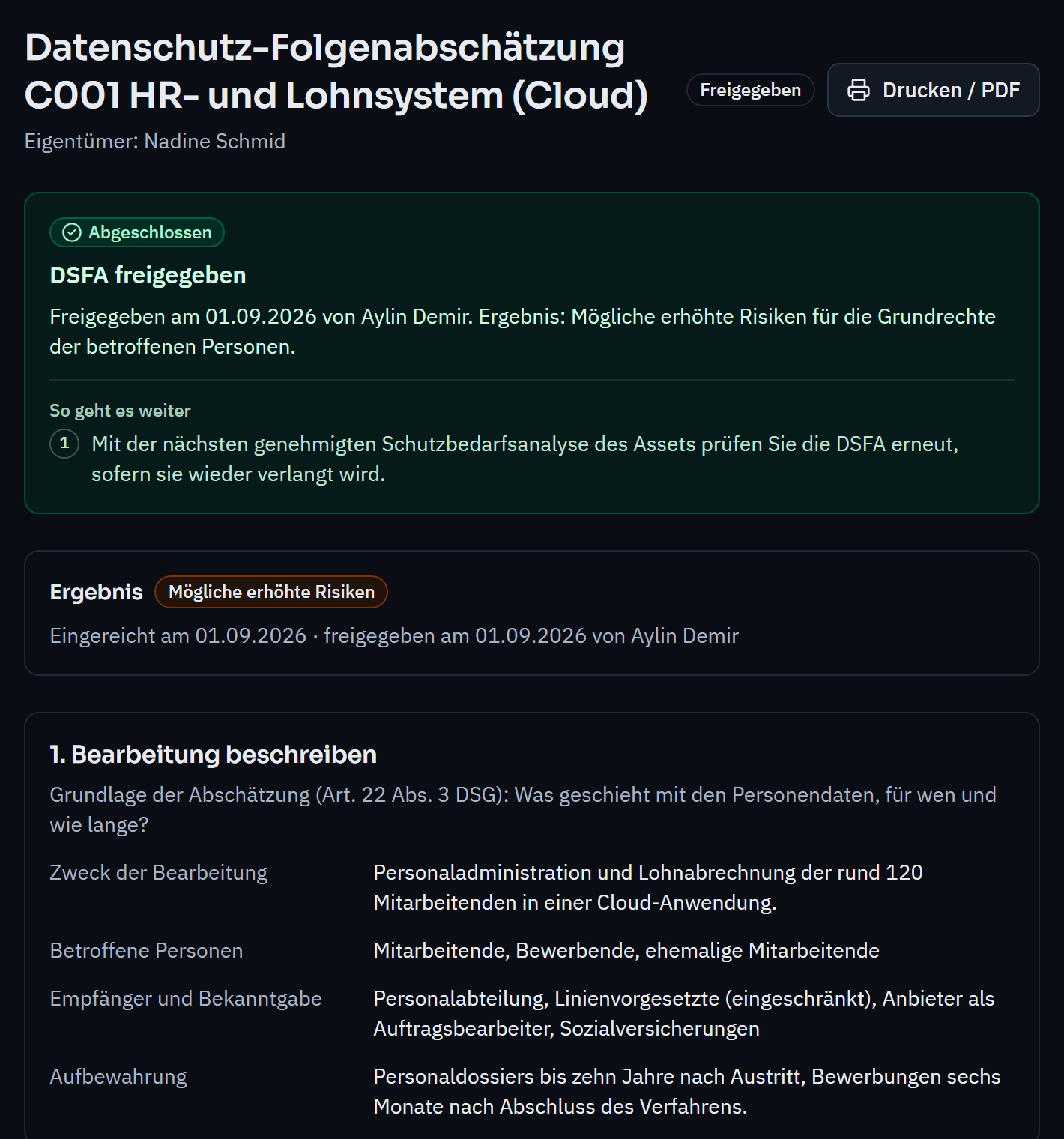
Where personal data is recorded.
The FADP for federal bodies and the ISA.
Under Art. 22 FADP, when processing may result in a high risk to the personality or fundamental rights of the data subjects, for example with extensive processing of sensitive personal data or systematic monitoring of public areas. Varmo suggests the decision based on your entries; your organisation’s assessment is what counts.
Varmo maps the Swiss FADP. If you are also subject to the GDPR, you can use the DPIA in Varmo as a basis, but you need to check the GDPR requirements yourself.
How close are you to ISO/IEC 27001?
In a personal demo, we show you the way to the readiness report, with no obligation. Or try it free for 30 days with every feature.