ISO/IEC 27001:2022
The standard in Varmo.
The Varmo ISO/IEC 27001 readiness check covers clauses 4 to 10 of the standard including Annex A, mostly from the data in your ISMS. For each clause, it shows whether an auditor would be likely to raise a major or minor nonconformity.
Included from the Starter plan
The check lays a test bench over your ISMS. Varmo answers most questions from what you record anyway: is there an approved scope, a valid information security policy, assessed risks with approved treatment plans, an up-to-date SoA, an internal audit and a management review from the last 12 months?
The overview lists each checkpoint with the clause of the standard and a short label from Varmo, not the text of the standard. You will find the exact wording of the requirements in ISO/IEC 27001:2022.
| Clause | Checkpoint | Basis |
|---|---|---|
| Clause 4: Context of the organisation | ||
| 4.1 | Internal and external issues | Data in Varmo |
| 4.1 | Climate change assessed | Data in Varmo |
| 4.2 | Interested parties and their requirements | Data in Varmo |
| 4.3 | Scope approved | Data in Varmo · critical |
| 4.4 | ISMS established and in operation | Data in Varmo |
| Clause 5: Leadership | ||
| 5.1 | Leadership and commitment of management | Data in Varmo |
| 5.2 | Information security policy | Data in Varmo · critical |
| 5.3 | Roles and responsibilities | Data in Varmo |
| Clause 6: Planning | ||
| 6.1.1 | Risks and opportunities addressed | Data in Varmo + short confirmation |
| 6.1.2 | Risk assessment | Data in Varmo · critical |
| 6.1.3 | Risk treatment and Statement of Applicability | Data in Varmo · critical |
| 6.2 | Information security objectives | Data in Varmo |
| 6.3 | Changes carried out in a planned manner | Data in Varmo + short confirmation |
| Clause 7: Support | ||
| 7.1 | Resources | Data in Varmo; until the first management review, also a short confirmation |
| 7.2 | Competence of key roles | Data in Varmo |
| 7.3 | Awareness | Data in Varmo |
| 7.4 | Communication | Data in Varmo + short confirmation |
| 7.5 | Documented information | Data in Varmo |
| Clause 8: Operation | ||
| 8.1 | Operational planning and control | Data in Varmo |
| 8.2 | Risk assessment at intervals | Data in Varmo |
| 8.3 | Risk treatment implemented | Data in Varmo |
| Clause 9: Performance evaluation | ||
| 9.1 | Monitoring and measurement | Data in Varmo |
| 9.2 | Internal audit (last 12 months) | Data in Varmo · critical |
| 9.3 | Management review (last 12 months) | Data in Varmo · critical |
| Clause 10: Improvement | ||
| 10.1 | Continual improvement | Data in Varmo |
| 10.2 | Nonconformities and corrective actions | Data in Varmo |
| Annex A | ||
| Annex A | Applicability assessed | Data in Varmo |
| Annex A | Exclusions justified | Data in Varmo |
| Annex A | Cross-check with risk treatment | Data in Varmo |
| A.5–A.8 | Implementation level per theme (4 checkpoints) | Data in Varmo |
Each checkpoint is met, partially met, open or not yet assessed; met counts in full, partially met counts half. For each clause and overall, a traffic light shows the status: green from 90%, amber from 60%. An open critical checkpoint turns the clause red. In the overall status, clauses 4 to 10 count for 75% and Annex A for 25%.
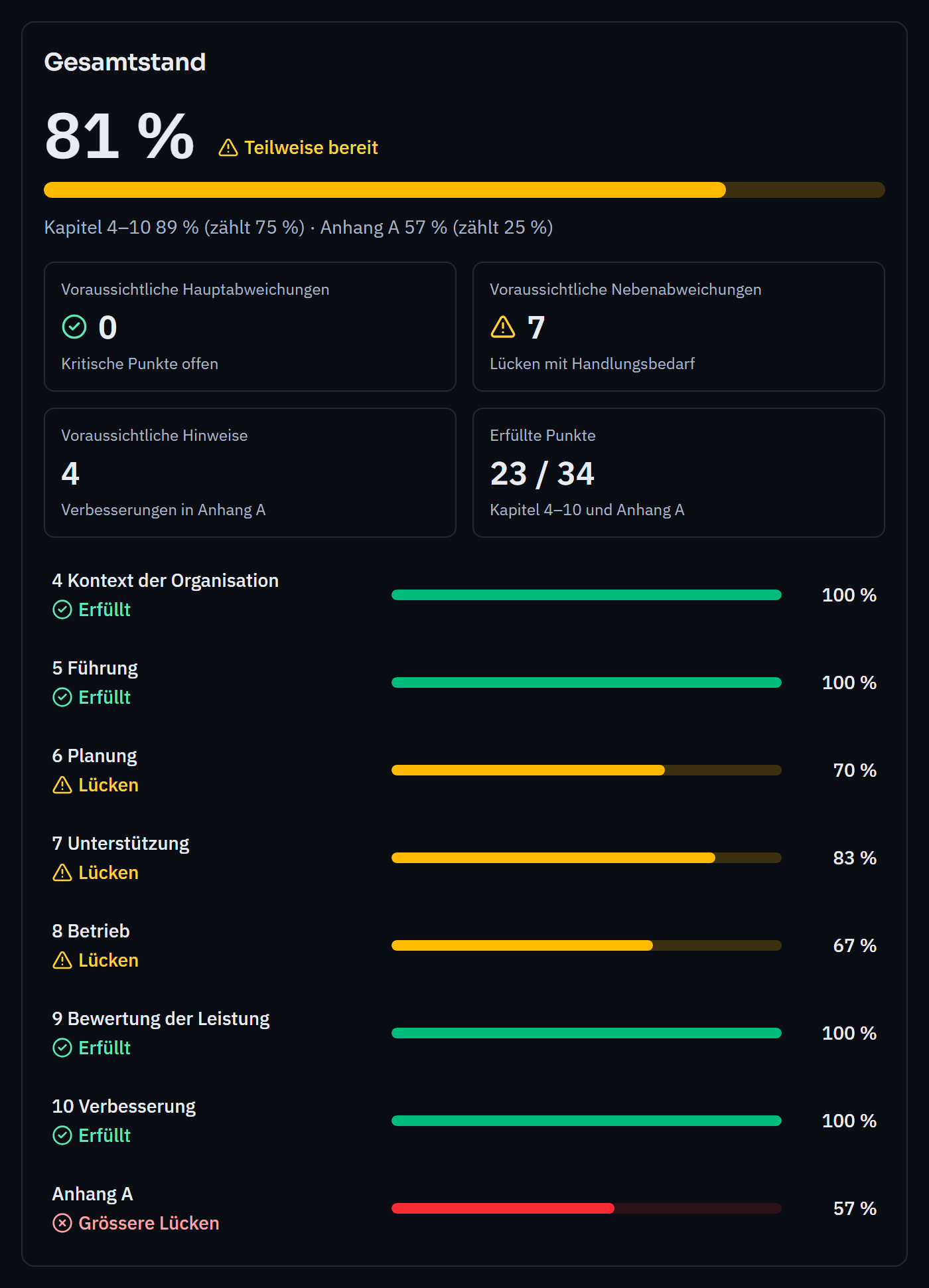
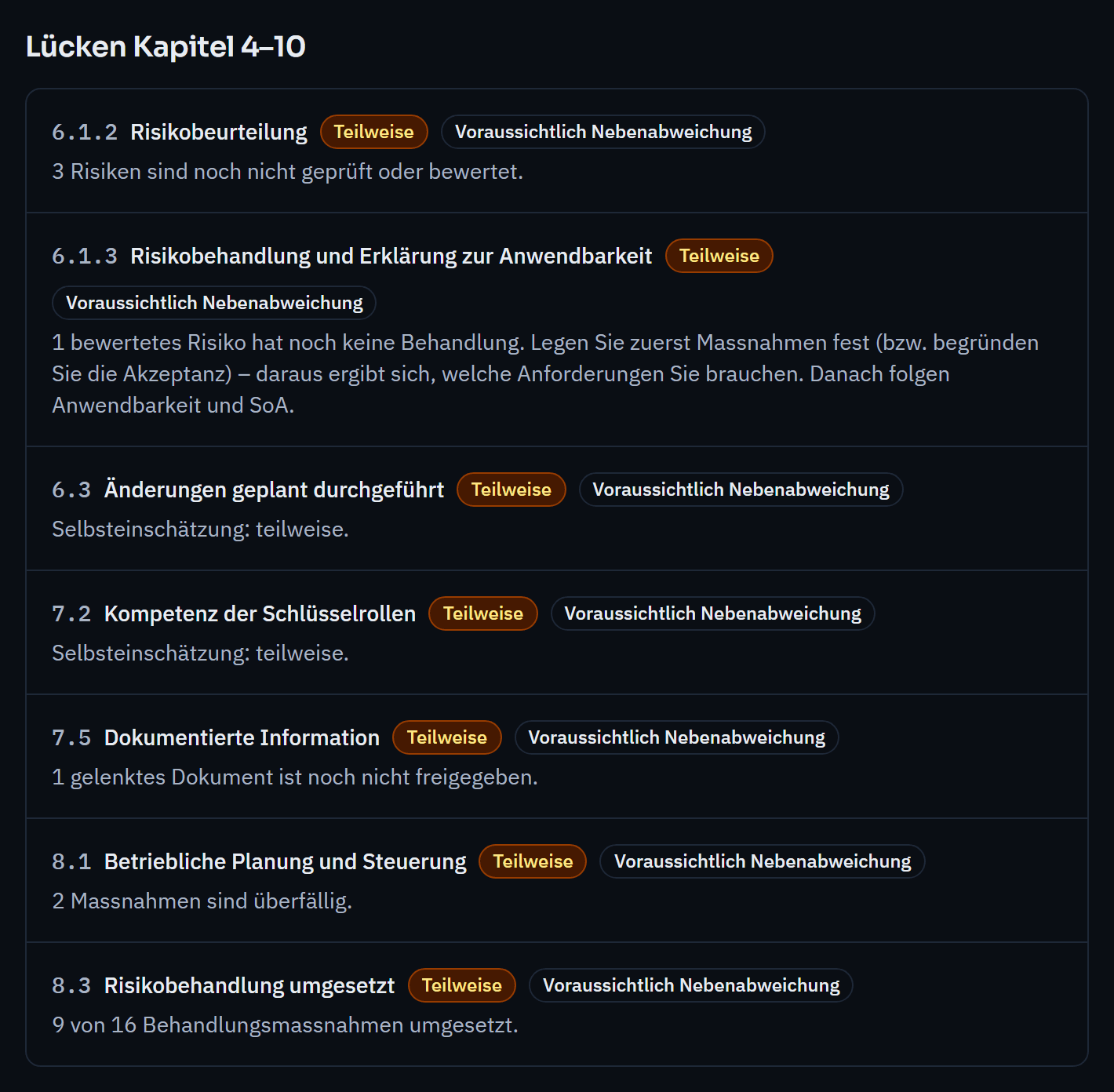
For every gap, the check names the clause of the standard, an auditor’s likely finding (major nonconformity, minor nonconformity or note) and exactly what is missing, such as “3 risks have not yet been reviewed or assessed”. A link takes you straight to the place where you close the gap.
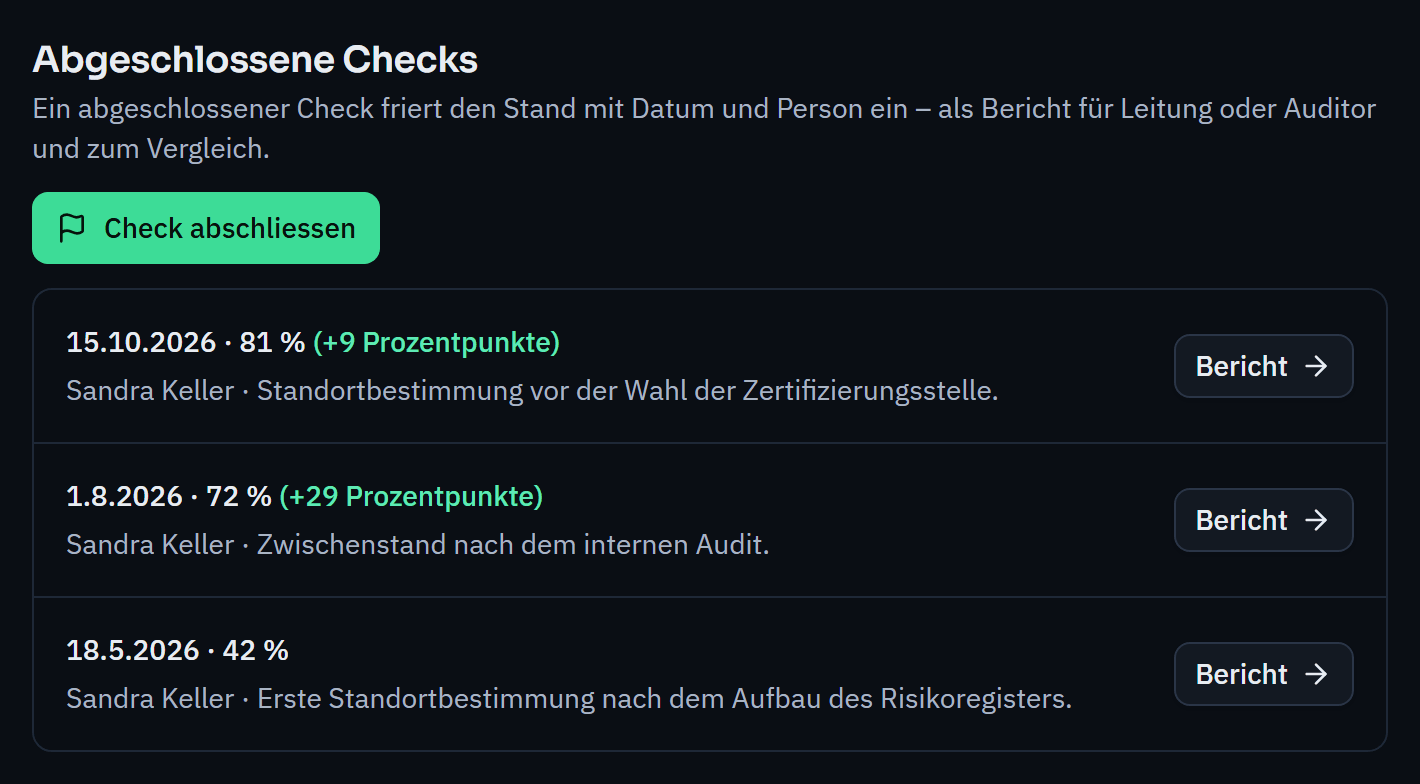
With “Complete check” you freeze the status with date, person and a note as a report, for management or the auditor. The history shows all completed checks and the change in percentage points, so you can demonstrate your progress. If you later move to a smaller plan, saved reports remain readable.
The readiness check helps you prepare. Whether your organisation is certified is decided solely by an accredited certification body.
The standard in Varmo.
Internal audit and management review in the same system.
The readiness check is included from Starter.
Yes, a continuous one: for each clause and for Annex A, it shows where your ISMS does not yet meet the requirements, with the likely finding and a link to the place where you close the gap. Because it evaluates the data in Varmo, you can run it again at any time, not just once before the audit.
When no critical checkpoint is open and the traffic light shows green, meaning at least 90% is met. Varmo treats open critical checkpoints such as scope, risk assessment or internal audit as a likely major nonconformity. The result remains a self-assessment.
None entirely without data. For three checkpoints (Risks and opportunities addressed, Changes carried out in a planned manner, Communication), Varmo first shows what it knows from your data, such as opportunities with a measure or communication per interested party; you confirm the checkpoint with a justification and, if you wish, with evidence. Resources is assessed by management in the management review; until then you confirm the checkpoint, and it counts as partially met at most. Confirmations are valid for 12 months.
No. The check is a self-assessment based on your data. Certification is carried out by an accredited certification body, which also checks whether the ISMS is actually lived.
That depends on your starting point. Many SMEs reckon on six to twelve months from start to certificate, because the ISMS has to run for a while before the audit, including an internal audit and a management review.
How close are you to ISO/IEC 27001?
In a personal demo, we show you the way to the readiness report, with no obligation. Or try it free for 30 days with every feature.